

The Architecturally Intelligent Business
More AI tools do not create a better system by themselves. Better results come from designing how data, people, systems, and AI work together.
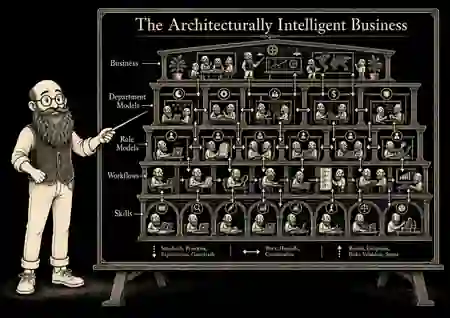
Businesses are rapidly moving from a handful of AI tools to an expanding number of AI-enabled capabilities spread across roles, systems, and departments.
At that point, the problem changes.
It is no longer simply how to use AI. It is how to organize it.
An assistant helps write something. An agent handles part of a process. A workflow is automated. A model is connected to company information. Each can create value, but without a larger structure, they can also become another collection of disconnected tools.
We believe the next stage of AI in business will be architectural.
Not just the technical architecture behind AI.
The operating structure of the business itself.
The goal is to design organizations in which people, software, automation, and AI can work through a shared structure with clear responsibilities, behaviors, standards, boundaries, and ways of coordinating with one another.
We think of this as an architecturally intelligent business.
And there is one distinction at the center of that idea:
Knowing what a business knows is not the same thing as knowing how the business should behave.
AI needs both.
That behavioral layer is the spine of the architecture. Capability Bundles define bounded behavior. Workflows coordinate it. Role Systems define how a job function should behave. Department Systems coordinate and govern behavior across roles. At the business level, broader priorities, standards, and guardrails shape how departments operate together.
It Starts With Capability Bundles
At the implementation level, the smallest reusable unit in this architecture is a Capability Bundle.
A Capability Bundle is a bounded operational capability designed to perform a specific kind of work. It might help find the right information, review a document, prepare an analysis, generate something from approved sources, validate work, identify an exception, or complete part of a larger process.
The important part is not simply that an AI model is capable of doing the task.
The behavior has to be defined and bounded.
We approach that design as a research-informed problem, not a prompt-writing exercise. Academic frameworks from behavioral science, organizational behavior, human factors, and systems thinking provide disciplined ways to define expectations, observe outputs, apply feedback, evaluate behavior against standards, and improve it over time.
A Capability Bundle needs clear rules for which information to use, what standards apply, what it is allowed to do, what a good result looks like, what permissions and authority it has, and when human review is required.